Gittin 45b: A sefer Torah written by a heretic must be burnt. Rashi: Because he certainly wrote it with idolatry in mind.
Rambam Yesodei Hatorah 6:8: One may not burn or erase a sefer Torah, but if it was written by a Jewish heretic, we burn it, including the names of Hashem, because he doesn’t believe in the holiness of Hashem and he did not write the name with Hashem in mind; he thinks the name is no different from any other word, so the name is not considered holy. And it is a mitzvah to burn it in order not to leave any reminder of the heretics or their actions.
אמר רב נחמן, נקטינן: ספר תורה שכתבו מין ־ ישרף. פירש”י ישרף־ דודאי לשם עבודת כוכבים כתבו.
רמב”ם הלכות יסודי התורה ו,ח: כתבי הקדש כולן ופירושיהן וביאוריהן אסור לשורפם או לאבדם ביד והמאבדן ביד מכין אותו מכת מרדות, במה דברים אמורים בכתבי הקדש שכתבם ישראל בקדושה אבל אפיקורוס ישראל שכתב ספר תורה שורפין אותו עם האזכרות שבו, מפני שאינו מאמין בקדושת השם ולא כתבו לשמו אלא שהוא מעלה בדעתו שזה כשאר הדברים והואיל ודעתו כן לא נתקדש השם, ומצוה לשורפו כדי שלא להניח שם לאפיקורוסים ולא למעשיהם.
It was early Shabbos afternoon in the basement of Shomrei Shabbos in Borough Park, where minyanim are held one after the other, every 20 minutes. In one particular minyan, the only kohein present was a man wearing a black hat who, the people said, was a mechalel Shabbos. The baal korei argued that this kohein should nevertheless be called up for the first aliyah because of the mitzvah of “v’kidashto” (sanctify the kohein by giving him the most honorable place), but the rest of the people there were against it. They pushed the baal korei and the mechalel Shabbos away from the sefer Torah by force, although he had already made the bracha, and called up a Yisrael.
Then someone said, “Wait a minute. This shul has a rav, Rabbi Yidel Tirnauer, who is upstairs right now giving a shiur. Why don’t we ask him what the shul’s policy is?” Two representatives went up to Rabbi Tirnauer and interrupted the shiur with this urgent question. The rav’s reply was, “They don’t have to call him up.”
[Rabbi Moshe Feinstein (Igros Moshe OC 3:12 and 22) rules that an atheist Jew may not get an aliyah, because to him saying the name of Hashem is just like saying any word, as the Rambam says regarding writing the name, and therefore his bracha is considered a bracha without Hashem’s name, which is not a bracha. If he does make a bracha, one may not answer amein. However, a Jew who believes in Hashem, but due to his desires or other pressures violates Shabbos, is allowed to get an aliyah. Still, Reb Moshe says that the aliyahs in the shul should be arranged such that he does not get an aliyah too often.
In OC 4:91:8 Reb Moshe adds that even if the mechalel Shabbos is a kohein, he should not be called. It seems he meant that even in the case when he believes in Hashem and can theoretically get an aliyah, one need not call him for kohein. Rabbi Tirnauer clearly followed this psak, saying that one need not call him (implying that occasionally, it is allowed to give him an aliyah if necessary, e.g. out of respect or appreciation).
In OC 2:50, Reb Moshe raises the question of whether Rashi disagrees with this ruling. Rashi says that the reason for burning the sefer Torah is because the heretic wrote it with idolatry in mind. If so, an atheist’s sefer Torah would not require burning, and perhaps his bracha is a bracha. (The logic would be that a name of Hashem recited without any intent – for Hashem or for an idol – is סתמן לשמה: it is automatically taken to mean Hashem.) However, Reb Moshe argues that in order to minimize the extent of the dispute between Rashi and the Rambam, we should say that Rashi only disagrees on the obligation to burn an atheist’s Torah. The Rambam gives the reason, “In order not to leave any reminder of the heretics or their actions,” and Rashi disagrees with this. But Rashi could still agree to the first half of the Rambam: that a name of Hashem written by a non-believer would have no holiness and one would be permitted (not obligated) to burn it. In Orach Chaim 215:10, the Mishnah Berurah cites a dispute between the Mechaber and the Gra as to whether one may answer amein after the bracha of an apikoros. In the Biur Halacha, he concludes that one should follow the Gra and answer amein, provided that he heard the entire bracha. Seemingly, this is against the ruling of Reb Moshe. But it may be that the apikoros in question there is someone who believes in Hashem but denies other principles of Judaism, whereas Reb Moshe is referring to an atheist.]

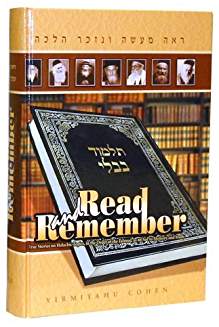
 Read and Remember